4 Apps That Changed How Our Family Experiences the Outdoors
- Mar 21, 2023
- 6 min read
Updated: Apr 26
App 1: AllTrails
AllTrails is the app I recommend to every single person who wants to start hiking, from complete beginners to experienced trail runners. It is the most comprehensive trail discovery platform out there, and it has genuinely transformed how I plan and explore the outdoors with my kids.
🗺️ What You Can Do With AllTrails
Search trails by location, length, and difficulty. Filter for kid-friendly, family, and stroller-suitable trails. Filter by activity: hiking, trail running, mountain biking, and more. Get driving directions directly to the trailhead. Track your steps and progress in real time. Navigate turn-by-turn so you never miss a junction. Read recent hiker reviews for current conditions. Create and save lists of trails to revisit later.
One of my favorite features is the ability to create trail lists. Whenever I discover a hike I want to do, I save it to a list. When I am ready to head out, I open the list, see what I have not checked off yet, and go. No last-minute research, no decision fatigue, just out the door and on the trail.
The recent hiker reviews are also invaluable, especially after rain or snow. Park websites are often slow to update trail conditions, but AllTrails reviews from hikers who were out there yesterday tell you exactly what to expect before you even leave the house.
💡 Pro Tips From Personal Experience
Always remember to end your hike before you drive away. I have made the mistake of getting in the car still tracking, only to realize at home that AllTrails now thinks I hiked thirty miles through my neighborhood. You cannot edit it after the fact.
Download maps offline before heading to areas with limited cell service. This requires the paid membership but it is one of the most practical features for hiking in remote areas.
Free vs. Paid: The free version is fantastic for getting started. The yearly membership at $35.99 adds offline maps, detailed trail information, wrong turn alerts, and ad-free use. Well worth it if you hike regularly.
Use code ADVENTUREMAMA30 for 30% off your annual AllTrails membership.
App 2: Seek by iNaturalist
If AllTrails gets you to the trail, Seek makes everything you encounter along the way endlessly more interesting. This is a nature identification app that uses your camera to identify plants, insects, fungi, birds, and animals in real time, and it has become one of our absolute favorite tools for hiking with kids.
🌿 What Makes Seek Special
Real-time identification: Point the camera at any plant, bug, fungus, or animal and Seek identifies it instantly. Works without cell service for basic identification, which makes it perfect for remote trails.
Designed for kids: Kids earn badges for new discoveries, which turns identification into a game they actually want to keep playing. It gives them a reason to slow down, look closely, and ask questions about the world around them.
Citizen science: Every identification your family makes contributes to a global biodiversity database used by researchers and scientists worldwide.
Privacy-friendly: Unlike the full iNaturalist app, Seek does not require an account and does not post observations publicly, making it the ideal starting point for younger children.
Trail activity idea: Turn identification into a friendly family competition. Who can find the most species in one hike? Keep a running tally and let Seek be the judge.
App 3: iNaturalist
Think of iNaturalist as the grown-up version of Seek, and an absolutely incredible tool in its own right. While Seek is perfect for quick, fun identification on the go, iNaturalist goes much deeper, connecting you to a worldwide community of naturalists, scientists, and passionate outdoor enthusiasts who are constantly updating, reviewing, and correcting identifications in real time.
When you submit an observation on iNaturalist, real people with real expertise actually look at your photo and weigh in. A professional botanist might confirm your plant ID. A local birder might correct a misidentification or add important context.
🔬 Why iNaturalist Is Different
Community-verified identifications: When enough qualified users agree on an identification, it reaches "Research Grade" status and is shared with scientific databases like the Global Biodiversity Information Facility, contributing directly to conservation research worldwide.
A living nature journal: Every observation you log becomes part of a personal record of where you have been and what you have found. Over months and years, this becomes a genuinely meaningful document of your family's outdoor life.
Discover what others have found nearby: Before a hike, you can search iNaturalist to see what species have been observed on or near your trail. It is a wonderful way to know what to look for before you even leave the house.
Real citizen science impact: iNaturalist observations have directly informed conservation decisions, helped track invasive species, documented climate change impacts on wildlife, and contributed to hundreds of peer-reviewed scientific studies.
How to use both together: Start with Seek for quick, fun, no-account identification with kids on the trail. When you find something especially interesting or unusual, switch to iNaturalist to log a proper observation, get it verified by the community, and add it to your permanent nature record.
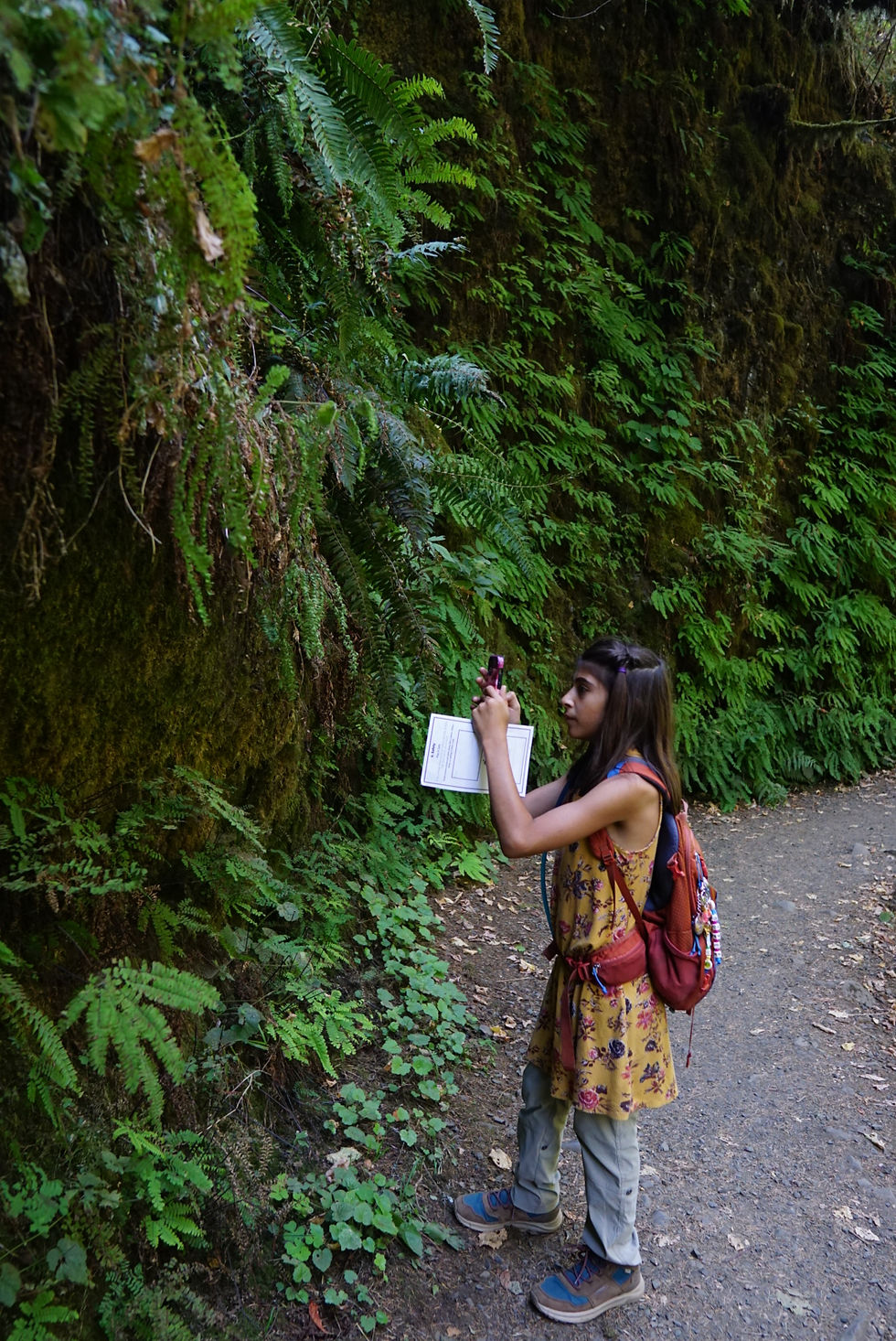
Using Seek to identify the type of Ferns
App 4: Merlin Bird ID
Merlin Bird ID is genuinely one of the most amazing apps I have ever used on the trail. It is completely free, made by the Cornell Lab of Ornithology, and what it does feels like magic the first time you experience it. You open the app, hit Sound ID, and Merlin listens to the birds singing around you and tells you exactly what species you are hearing in real time.
Even better, it picks up multiple birds at once. You might be standing on a quiet trail thinking you only hear one bird, then look down at your screen and see Merlin has detected five different species singing in the trees around you. It is genuinely fun to use out on the trails and instantly turns every walk into a birding adventure.
🐦 Why Merlin Is Special
Sound ID: Just open the app when you hear birds singing and Merlin detects the calls and tells you what bird it most likely is. It can identify dozens of species simultaneously and updates as new birds chime in.
Photo ID: Snap a photo of a bird and Merlin will identify it from the image. Great for the times you can see the bird but cannot quite hear it.
Step-by-step ID: Answer five simple questions about the bird's size, color, and behavior, and Merlin gives you a shortlist of the most likely species in your area. Perfect when you only got a quick glimpse.
Completely free: No account, no subscription, no ads. Made by the Cornell Lab of Ornithology, one of the most respected bird research institutions in the world. The data and models behind Merlin come from millions of citizen scientist contributions.
Works offline: Download the bird pack for your region and Sound ID works without cell service, which is essential when you are deep on a trail with no signal.
Why kids love it: There is something genuinely magical about hearing a bird, opening the app, and immediately learning its name. My kids start asking what the bird looks like, what it eats, where it migrates to. Merlin opens the door to all of it. It absolutely turns a regular hike into an adventure where every chirp becomes a small mystery to solve.
🏅 Badges, Challenges and Keeping Kids Engaged
Both Seek and iNaturalist reward exploration with badges and challenges that kids genuinely get excited about. The more species they identify, the more badges they earn, and seasonal challenges give them specific things to hunt for on each hike. This turns every trail into a scavenger hunt with real scientific purpose behind it.
One of the things I love most is how naturally these apps open up conversations about whether a plant or animal is native or invasive to the area. Kids start to understand that not everything that looks beautiful belongs there, and that the health of a local ecosystem depends on balance. That kind of ecological thinking, learned on a trail at age seven or eight, stays with a child for life.
Sometimes the apps struggle to zero in on a very specific species. But rather than seeing that as a failure, we use it as an invitation to dig deeper at home, look it up together, and turn uncertainty into curiosity.
Have a favorite trail app I missed? Drop it in the comments. I am always looking for new ways to make our time outside even richer.
If you are looking for somewhere to use all of this, our full list of Bay Area family hikes by age and ability is a good place to start. 33 trails, all real recommendations.


Comments