How to Actually Get Out the Door for a Hike With Your Kids
- Mar 10, 2023
- 7 min read
Updated: Apr 26

The honest answer is that it is less about logistics and more about mindset. And once you shift the mindset, the logistics become surprisingly manageable.
I have done this dozens of times, with three kids at wildly different ages, with and without my husband, in all kinds of conditions. None of it is perfect. All of it is worth it. Here is exactly how we make it work.
Step 1: Plan a Few Days Ahead
Spontaneous hikes are wonderful in theory. In practice, with kids, a little advance planning is what makes the difference between a smooth morning and a chaotic one. I try to decide where we are going at least two to three days before we plan to leave, which gives me time to check trail conditions, weather, parking, and how long the drive will be.
📋 What to Figure Out in Advance
Drive time: If it is an hour away, plan to wake up at least two hours before you want to be at the trailhead.
Trail conditions: Check AllTrails reviews from the past week, especially after rain. Nothing derails a hike faster than arriving to a closed trail or knee-deep mud you were not prepared for.
Parking: Popular trailheads fill up fast on weekends. Check if you need a reservation or if there is a fee, and have a backup spot in mind.
Sunrise time: For the best experience and to beat the crowds, aim to arrive at the trailhead as early as possible.
Step 2: Mentally Prepare the Kids the Night Before
This is probably the single most underrated piece of the whole puzzle. When kids know what is coming, they show up differently. The night before any hike, I sit down with my kids and tell them exactly what we are doing: where we are going, what we might see, how long we will be driving, and what to expect on the trail.
We also use this time to check the weather together and lay out their clothes so there are no morning debates about what to wear. Layers go on the chair. Extra change of clothes goes in the bag. Done.
Step 3: Pack the Night Before
This one changed everything for us. Packing the night before means the morning is nothing more than get dressed, eat breakfast, get in the car. No scrambling, no forgetting things, no stress.
🎒 What Goes in the Pack
Water: More than you think you need. I bring enough for the whole hike plus extra, always.
Snacks and lunch: Calorie-dense, easy to eat on the trail. Think trail mix, nut butter pouches, fruit, sandwiches, and something special that feels like a treat at the summit.
Extra change of clothes: For everyone, not just the youngest. Mud and creeks are unpredictable and wonderful.
Journals and pencils: The kids draw what they see, write down species they identify, and create a record of every adventure that we look back on for years.
First aid kit: Small and light. Bandages, antiseptic wipes, tweezers for ticks and splinters, and any personal medication.
Sunscreen and bug spray: Apply before you leave and pack both for reapplication.
Step 4: Let the Kids Pack Their Own Backpacks
This is one of my absolute favorite things we do. Every child, even the youngest, gets their own backpack to pack for the trail. It gives them ownership of the adventure before it even begins. They make decisions. They take responsibility. And they show up to the trailhead feeling like a real hiker with a real role to play.
When my girls were toddlers we used small CamelBaks with a hydration bladder that were perfectly sized for little shoulders and big enough to hold a snack or two, a small toy, and a few trail treasures on the way back.
What kids love to carry: Their own water, a snack they chose, a journal and pencil, a magnifying glass, a small field guide or nature bingo card, and plenty of room for rocks, pinecones, and other treasures they collect along the way.
A Few More Things That Help
✅ Small Habits That Make a Big Difference
Start with shorter hikes and build up. Two miles is a real accomplishment for young kids and there is absolutely no shame in it.
Let them set the pace. A curious kid crouching over a beetle is not slowing down the hike. That is the hike.
Give them a job. Trail leader, wildlife spotter, map reader, snack distributor. Kids who feel useful feel invested.
Celebrate everything. Every summit, every mile, every animal spotted. Make a big deal of it.
Do not cancel because of imperfect conditions. Some of our most memorable hikes have been in the drizzle, the mud, and the cold.
Getting out the door is always the hardest part. Once you are on the trail, everything else takes care of itself. Your kids will surprise you with how far they can go and how much they are paying attention. And you will surprise yourself with how much you needed it too.

Step 5: Bring Binoculars
This is one of the simplest things you can add to a hike that completely transforms the experience for kids. Binoculars turn every trail into a wildlife observation mission. Birds in the treetops, deer on a distant hillside, hawks circling overhead: suddenly all of it is close and real and exciting.
🔭 How to Use Them on the Trail
Make it a game. Give kids a list of things to spot through the binoculars: a bird in a tree, an animal moving on a hillside, a flower on a far ridge. The Seek app pairs beautifully with binoculars since kids can spot something from a distance, then get close and identify it.
Step 6: Snacks, Snacks, and More Snacks
If there is one thing I have learned after hundreds of miles on the trail with three kids, it is this: you cannot bring too many snacks. You will think you have packed enough. You will be wrong. Pack more.
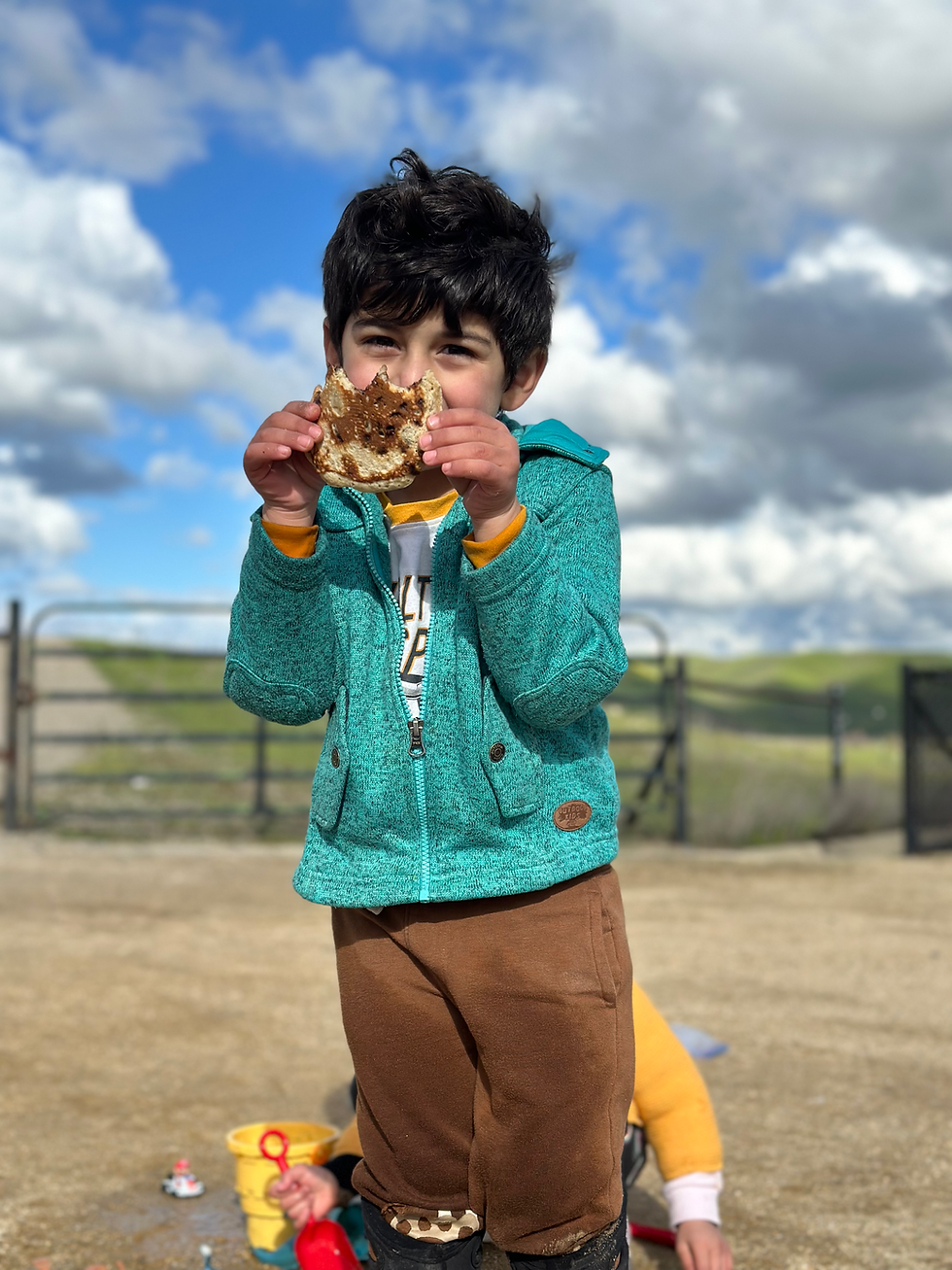
We have turned snack time into one of our favorite trail traditions. One of the kids' longtime favorites is bringing pancakes: filling, protein-packed, easy to eat with your hands, and genuinely delicious cold on a trail.
🎒 Our Trail Snack Strategy
Fuel snacks: Things that provide real, sustained energy. Trail mix, nut butter pouches, cheese and crackers, fruit, pancakes, hard-boiled eggs, and granola bars.
Fun snacks: Pretzel sticks are a longtime trail favorite in our family. We use them to make shapes, letters, and silly designs at snack breaks which turns a rest stop into a game.
Emergency snacks: Keep a small stash of your child's absolute favorite treat for exactly the moment someone is melting down. We love Zollipops and Trader Joe's Fruit Wraps. They have saved more than a few hikes.
Honest tip: Do not wait until someone is already in meltdown mode to break out the special snacks. Use them proactively. Think of it as preventative care.
Whatever your kids love most, bring it. No matter how many snacks you pack, somehow they always all get eaten, and you will never once wish you had brought less. Pack more. Always.

Step 7: Start Small and Build From There
If you are brand new to hiking with kids, the single most important thing you can do is resist the urge to go big on your first outing. Choose a hike that is short, easy, and genuinely enjoyable at a slow pace. The goal of the first few hikes is not mileage or elevation. It is creating a positive association with being outside on the trail.
A successful short hike that ends with happy kids is worth infinitely more than an ambitious one that ends in tears. The short hike is the one that actually gets repeated.
🥾 What to Look For in a Beginner Hike
Short distance: One to two miles round trip is plenty for young kids and toddlers.
Minimal elevation gain: Flat or gently rolling terrain keeps the pace manageable.
Something interesting to discover: A creek, a waterfall, a meadow, a viewpoint. Give kids something to look forward to and move toward.
Easy access parking: Eliminate as many variables as possible on the first few outings.
Step 8: Always Be Flexible
This might be the most important mindset shift of all. You can do everything right: plan ahead, pack the night before, prep the kids, arrive at the trailhead excited and ready, and still have a toddler who simply refuses to walk. It happens.
For exactly this reason, I always keep a small stash of backup activities in the car: sand toys, scooters, a frisbee, sidewalk chalk. On the days when the trail is not happening, we just move the adventure to the parking lot or the grassy area near the trailhead.
Reframe what success looks like: Getting outside with your kids IS the goal. Whether you hike two miles or sit on a rock for twenty minutes watching a bug, you showed up and you went outside together. That matters far more than any mileage.
Every time you show up, even when it does not go to plan, you are building something. The next time you go, your toddler will venture a little further. The time after that, a little further still. None of it is wasted.


One last thing to always keep in the car: Sand toys, a frisbee, sidewalk chalk, a scooter. You will be surprised how often they save the day when the trail does not happen but outside still does.
Every family finds their own rhythm with this. What works beautifully for one child may not work for another. Give yourself permission to experiment, to adjust, and to occasionally arrive home muddier and more exhausted than you planned. Those are usually the best days.
And once you are out the door, here are the best family hikes in the Bay Area sorted by age and ability, from toddler walks to serious summit hikes. 33 trails, all tried and tested.


Comments