Carrying Syria Home
This post was originally written in real time as a daily journal during my humanitarian trip to Turkey and Syria in March 2013. I am sharing it here now, over a decade later, because it deserves a permanent home, and because the people I met deserve to have their stories told. I will be sharing it in full, from arrival to goodbye, ending with something that happened in December 2024 that I have been waiting a long time to write about.
I Was Born in Damascus
This story begins in a city I cannot think about without my chest tightening. Damascus. I was born there in 1984, and my family left when I was four years old. We came to California and built a life, and I grew up in two languages, two cultures, carrying a homeland inside me that I had not lived in long enough to fully remember but could not stop missing.
In 2011, Syria erupted into civil war. I was twenty-seven years old, a new mother, watching the news the way you watch something happen to your own family, because it was. The cities being shelled were cities I had heard about my entire life. The people dying in the streets spoke my language, shared my faith, carried my blood. For months I sat with that weight and did not know what to do with it except grieve.
In March 2013, with my daughter who was 1 year old at home, I left her in the care of my family, boarded a flight to Istanbul, and crossed the border into Syria on foot.
What follows is the journal I kept in real time during those two weeks. I wrote it on a cracked laptop screen, from a room in southern Turkey, often past midnight with Turkish tea going cold beside me. I am sharing it here now, over a decade later, because it deserves a permanent home. And because something happened in December 2024 that made telling it feel urgent in a way it never quite had before. I will get to that at the end.
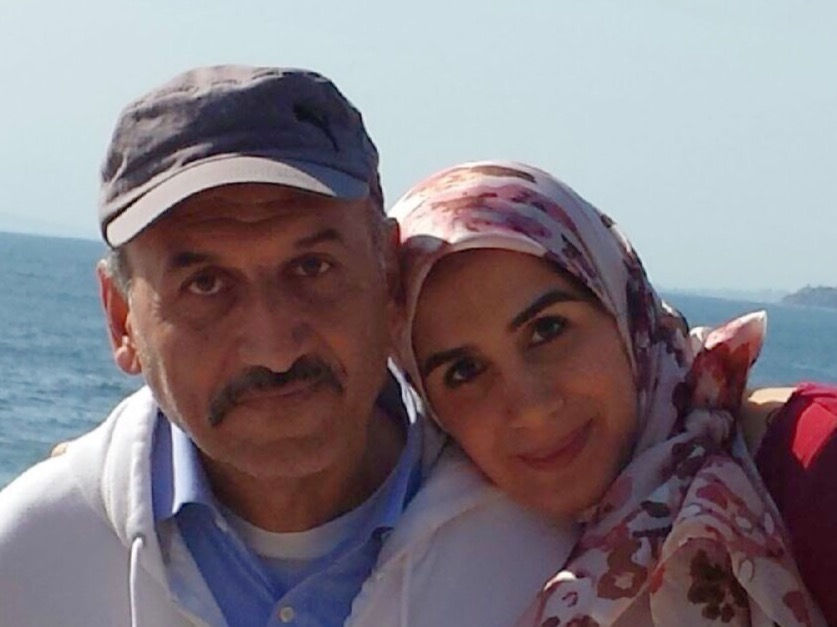
My Father
The person who made this trip feel not just possible but necessary was my father. He is one of the most bighearted people I have ever known, and from the moment the uprising began in Syria, he redirected himself entirely toward it. Meetings. Protests. Late night phone calls. Fundraisers. He woke at 5 a.m. and did not come home until after midnight, and when we spoke on the phone I could hear something in his voice I had never heard there before. Weight. A heaviness that did not lift.
In November 2012, he suffered a sudden cardiac arrest. Alhamdulillah, he was home. Alhamdulillah, he survived and was improving. But something shifted in me during those weeks. I sat beside him and made a decision I had been circling for a long time. I would go. Not just fundraise from a living room in California. Go.
Walk4Syria

Before I could go, I needed to raise money to bring with me. My friend Sama, who had already made multiple humanitarian trips into Syria, connected me with Puneh. From the first conversation we knew we were made of the same thing: people who had been watching from the sidelines and could no longer stand it. So we did something practical. We organized a walkathon called Walk4Syria, held on March 2nd.
People came. They walked. They gave. Kean Coffee handed out free coffee at the start. Fresh Choice Falafel had sandwiches waiting at the finish. It was full of warmth and intention, a neighborhood coming together for people they had never met and would never meet, but chose to show up for anyway. Every dollar raised went directly to refugee families. Not a single cent went toward my personal expenses.

March 27, 2013: Istanbul
The night before my flight, a call came asking if I could carry four extra pieces of luggage filled with medical supplies. I said yes before the question was finished. The next morning there was airport chaos, an overweight bag, extra fees, a scramble before dawn, and none of it mattered at all. Those supplies were going to people who needed them more than I needed a smooth departure.
Sixteen hours later, almost no sleep in twenty four hours, I walked into Istanbul airport and felt something I had not prepared for: relief. A Muslim country. Arabic in the air. A familiar cadence to the movement of people around me. My body exhaled before my mind understood why.
But the relief did not last. All around me, people were on vacation. Honeymooners. Families with matching luggage. Tourists laughing at cafe tables. Normal life in full, easy bloom. And three hours away, people were hiding underground to survive. I found a small cafe, ordered Turkish coffee, and watched the world move around me while I held the weight of where I was going.
Arriving in Gaziantep
An hour and a half more by air and the whole world changed register. Gaziantep airport was small and dim, the ceiling cracked, the fixtures worn. Maybe a hundred people total. I stepped into the bathroom to freshen up, and when I came out just minutes later, the terminal was nearly empty. Everyone had already grabbed their bags and gone, moving with the brisk quiet of people who do not linger. It felt like stepping into a different film entirely.
Outside, a family was waiting for us. Complete strangers who welcomed us with the immediate, unearned warmth of people who had decided before we arrived that we were worth caring for. They took us home, cooked dinner, made tea, and began telling us what they had seen. Months of questions I had been carrying inside me started coming out. For the first time since making the decision to come, I felt like I was receiving real information. Not news coverage, not secondhand accounts, but the testimony of people who had lived it.
I had not slept in thirty hours. I did not want to sleep.
A Story That Broke My Heart
That first night I met a woman who rearranged something permanent inside me. She worked at the local hospital as a translator for Syrian refugees, every single day, for months. She saw teenagers arrive with bullets lodged in their spines. Young men with shrapnel in their faces and chests. People with limbs severed, with wounds untreated for days because there had been no way to reach a hospital sooner. She absorbed all of this daily and then went home and made dinner for her children.
She told me all of it quietly, the way people speak when they have trained themselves not to break in front of others. Then tears gathered in her eyes and she said:
Then she told me about a nine month old baby boy who had arrived at the hospital alone. No parents. No one. Just a tiny baby with cuts across his beautiful face, somehow delivered to those doors and somehow still alive. Despite everything he had endured, he was smiling. Playing with the nurses. Nine months old and already a survivor of something most adults could not survive. A neighbor from his family's village eventually arrived looking for his parents and found only him. She took him in and raised him as her own.
She showed me his picture on her phone. Her hands shook slightly. She told me she still thought about him.
I had just left my own baby at home, a few months old, barely sleeping, still learning what her own hands were. And I sat in that room in Turkey looking at a photo of a baby who had lost everything, held by a woman who wept for a child she would never stop thinking about. I did not ask why out loud. But the question settled into me that night and has not fully left.
March 28, 2013: Hospital Rounds

The next morning we visited Gaziantep University Hospital, where the translator worked. Walking through those doors required everything I had. I knew in theory what I was about to see. But knowing something intellectually and standing inside it are two entirely different experiences, and nothing I had read, watched, or imagined had adequately prepared me for the physical reality of it.
We moved from room to room, beginning with the less severe injuries and working toward the worst. I felt nearly paralyzed. I was terrified of appearing like I had come to observe, to take something from people who had already lost everything. My mouth was dry. Neither of my languages would come. It felt like standing under a heat lamp while the room turned slowly around me. I had to breathe and remind myself: this is why you came. Do not leave your body right now.
I met many people that day, young men and older men, most of them Free Syrian Army soldiers struck by bombs or bullets. When I asked each of them what they needed, almost every one said the same thing: nothing. We are okay. Just pray for us. They had made it to the hospital. In their own accounting, that made them the lucky ones.
Then I met Rami. Eleven years old. A patch over his right eye where a bullet had hit him. Bandages covering both arms and both legs. He sat very still with his one good eye fixed on the floor, as if eye contact were a resource he could not afford to spend. I reached into my backpack and pulled out a handmade card made by a child in America specifically for Syrian refugees and handed it to him gently. I told him that children all over the world were thinking of him. That people who had never met him loved him. That he was not invisible to anyone.
He did not look up. But after a long, careful silence, the corner of his mouth moved. The smallest possible smile. And so quietly I almost missed it, he said:
I left his room carrying him with me. I still do.

The last boy I met that day was named Mohammad. He was lying in bed playing quietly with puzzle pieces, his parents seated on either side of him in the particular stillness of people who have run out of things to do except wait. His father told me the story in a low, steady voice. Mohammad had been at a park near their home with six cousins and his eleven month old baby brother when a bomb hit. All six cousins died. The baby died. Mohammad alone survived. He had been through five surgeries on his legs. He had not spoken since.
His mother looked at me with the calmest eyes I have ever seen on a grieving person. I asked how she was. She said she had still been nursing her eleven month old when they arrived. She missed him. Then she said what every person in that hospital had said: we need nothing. Just prayers.
I held her. There were no words that were not inadequate. I just held her while her surviving son rearranged puzzle pieces in the bed beside us, and I stayed there for as long as she needed.
March 29, 2013: Toward Reyhanli

The next morning I was on a bus toward the border. Four and a half hours through landscape that stopped me every time I looked at it, rolling green hills, children playing along the road, streams cutting through valleys below. I kept looking out the window thinking of the summers my family used to drive through Syria when I was small. The back seat, watching the same kind of world scroll past. How whole everything felt then. I was on the same kind of road now, heading somewhere entirely different.
Midway through, a man in the seat ahead stood up and I saw a gun in his pocket. I froze. My companion noticed too. Nobody else on the bus reacted at all, not a glance, not a shifted posture. Weapons had become ordinary. That quiet normalization, more than almost anything else I witnessed, is what haunted me.
When we arrived at the Watan office in Reyhanli I felt immediately that I was somewhere serious. And right at the entrance, two Syrian boys aged eleven and thirteen were unloading boxes of baby formula, competing loudly over who could carry the most. One grabbed six boxes. Another swiped one. I do not want you to get tired, the second boy grinned. I should carry them. They both erupted laughing. I had not laughed out loud since California. Those two boys gave me that.
April 1, 2013: Crossing Into Syria
The original plan was to work from Turkey. But I arrived in Reyhanli and I could see the mountain on the other side, and I knew Syria was less than forty minutes away on foot, and something inside me that had been traveling toward this moment for two years simply would not stop at the border.
People warned me. It is dangerous. You will have to cross by foot. Are you crazy? Are you asking to die? I said what I believed then and still believe now: if it is my time, it will happen wherever I am. That is not recklessness. That is faith, and it was the only thing keeping me upright.
We bought coloring books, pencils, puzzles, and toys for the children. Ahmed, a young Syrian man who would become our anchor for everything that followed, drove us in. Three car switches. Three checkpoints. And then we ran on foot across the border into Syria.

Once inside, we drove in near total darkness with the headlights off, stopping every few minutes as bombs landed somewhere ahead, close enough to feel but far enough that we kept going. There was a truck behind us loaded with flour to make bread for the families in the villages. The regime bombs anything that moves. Ahmed drove without speaking. I prayed.
We reached Ziad's home in southern Idlib safely. Alhamdulillah.

Ziad was a former school principal, mid thirties, a man of quiet dignity and enormous influence in the area. His three children ran in when we arrived. One shook our hands solemnly. The other two peeked from behind the doorframe and giggled. His wife had prepared a late dinner and embraced us as though we had always belonged there.
April 1, 2013: The Hospital and the Baskets
The following day we visited Al Mashfa Madani, the best hospital in southern Idlib. In March alone, over 1,300 people had died there. Over 5,000 since the war began. I want you to sit with that number before moving past it.

There was blood on the floors. Medications close to expiration or already expired. Equipment that would be considered outdated anywhere with functioning infrastructure. The man running the hospital was composed and completely dedicated. When I asked what they needed, he gave me a precise, quiet list: anti scabies treatment, anti infection medication, pediatric medicine, baby formula, anesthesia supplies. The bare minimum for keeping people alive. I arranged for supplies to be delivered. Everything came together. Alhamdulillah.
That same day, Puneh and I made 200 food baskets for the families living in underground caves in the surrounding villages. Each one held rice, sugar, tea, cooking oil, butter, canned meat, sardines, tomato paste, chocolate. Small things assembled carefully, one by one, against an enormous and consuming need. We packed them late into the evening with people who showed up to help without being asked.
That night the women sat with me and held my arms for hours. They asked why this was happening to them, what they had done, where God was in all of it. I had no answers. I never do. But I could stay, and I could listen, and that mattered. Not because it was enough, but because presence is sometimes the only thing left to offer.
April 2, 2013: One Hour in Paradise
Before the day began its full weight, Puneh and I slipped outside at dawn to say our prayers in the open fields. The sky was still pale. The land around us was impossibly green, rolling, quiet, unhurried beauty that somehow did not know it was inside a war.

Then the children found us. They came running out in ones and twos and then in a whole joyful crowd, barefoot and completely at ease, and we lay down in the grass with them. Red and white and yellow wildflowers growing everywhere. Tickling, chasing, laughing, taking pictures. For one complete hour there was nothing but these children and the flowers and the wide open sky.
Bombs were sounding somewhere in the distance the entire time. The children did not flinch. They had grown up with that sound as the backdrop of their childhood, and that, more than almost anything else I saw on the entire trip, broke something open in me.
April 2, 2013: Living the War
That same morning, Puneh and I loaded 75 baskets onto a truck and headed into the villages to distribute them. I rode in the back. The drive out was stunning, clear sky, green hills, quiet. I was handing out baskets, giving children the handmade cards from home, watching their faces when they understood that someone far away had thought specifically about them and made something just for them. In those moments, something real passed between us.

Then I went into the underground homes. Not shelters. Caves dug into the earth where families had taken refuge. No electricity. Almost no water. The faces looking up at me were stripped of everything except endurance. What good, their eyes seemed to ask, is a bag of rice to a person who does not know if they will be alive to eat it?
Fifteen minutes in, a man burst from his home screaming at us. Get out. We do not want your food. We do not want your pictures. The last time people like you came here we got bombed and I lost my family. His voice broke on those last words and the scream beneath the scream was audible, the sound of grief past the point of containment. I stood completely still and felt the truth of what he was saying land in my chest like something physical.
Ziad took me quietly by the arm and asked me to step inside a nearby room for just one moment. I went. Sixty seconds later: three bombs. Back to back to back. The floor shook. The walls vibrated. And my mind reduced itself to a single word.

We ran to the car and drove toward Ziad's home. As we arrived I could see all the women and children I had spent the past two days with, screaming in the street. Mahasin was gone. A newlywed woman, nine months pregnant. The bomb had found her. The house beside hers had held sixteen people, including another pregnant woman whose husband had just been killed in the same strike.
Puneh was in the underground room with Ziad's wife and children. Safe. Six hundred feet from the impact. Six hundred feet.
The village was coming apart. Children screaming. Men moving with the quiet, practiced urgency of people who had been making survival decisions for months. And then the women saw me and took my hands and would not let go: Why us? Is there a God? What have we done? I cannot take this anymore. Please. Take us with you.
I wanted a truck. I wanted to put every single one of them in it and drive until we reached somewhere safe. I had no truck. I had nothing except my arms.
Puneh said: we need to leave. Right now.
I saw my daughter's face. My few months old baby at home, waiting for me.
Yes. Let's go.
April 5, 2013: The Children and the Women
Back in Reyhanli, there was still work to be done. Puneh and I visited the children's center near the Watan office. It had opened in February with 300 registered students and six to eight teachers running programs from nine in the morning until five. The walls were covered in the children's drawings, their Arabic letters practiced in careful rows, their artwork in every color. Walking in felt like breathing.

When recess began and hundreds of children flooded the courtyard all at once, it became one of the most joyful moments of the entire trip. They wanted to be in every photo, to tell me their names and where they were from, to show me how fast they could run. They sang songs about a free Syria with a conviction so total it left no room for doubt. They were alive in a way that demanded to be witnessed.

The principal Raghad told us what they needed: a printer, file organizers, materials to keep the students motivated and engaged. We went out and found a printer with two toner cartridges and brought it back. As Puneh always said at moments exactly like that: are you ready to be Santa Claus? Every single time: yes.
While searching the streets for the printer, I passed a fabric shop and stopped. I bought three fabrics, a deep green, a purple leopard print, and a floral pattern whose colors kept pulling at something in me, the colors of Syria itself, and brought them to a group of Syrian seamstresses working in a room just next door. Six women earning almost nothing doing piecework. I explained what I wanted: twelve scarves for the refugee women in the area.

Six women measured, cut, and sewed twelve perfect scarves in under an hour. While their hands moved, they talked. They told me how Turkish shopkeepers raised prices on them the moment they knew they were Syrian. How little the work paid, and how they wanted nothing more than someone to teach them to sew better so they could earn enough to feed their families. Not charity. A door. I wrote down the name of the fabric store for them. It was the only door I could open.
I was writing all of this on a cracked screen. Layal had broken it a few days before I left. Every night, working past midnight by the light of that cracked screen, I looked at it and smiled. Because it meant she was on every page. Thank goodness for good Turkish tea.
April 12, 2013: My Heart
The time came to leave.
The goodbye I will never fully process.
I held the women and cried with them and felt, for the first time in my life, completely lost for words in a way that had no floor to it. There was nothing to say. I simply held them, and they held me back, and we stood together in the middle of a village being bombed, and that was all there was.
Why us? Is there a God? What have we done? If they get any closer I will have to leave. Please, please take us with you.
I knew going home was right. I knew I could do more for them from the outside than I could by staying. And I also knew that those women had to remain in a place that was actively trying to kill them, and I did not, and that knowledge sat in my chest like a stone the entire flight home.
Syria, you are in my heart. You will be rebuilt. You will be free. May Allah protect every soul that remains inside you.
I will see you soon.
Coming Home
Coming home is its own disorientation nobody warns you about. You pick up your baby, who has kept growing without you, who smells exactly the same, who reaches for you like you never left. You make coffee in your own kitchen. You sleep in your own bed. And none of it feels entirely real because part of you is still in a village in Idlib, still in that underground room, still hearing the sounds of that afternoon.
A few weeks after returning, I was at a friend's birthday party. People were laughing, music was playing, the evening was light and easy. Then the Disneyland fireworks started across the distance. And I froze, not metaphorically, but physically, bodily. The sound took me straight back. Bombs. Screaming children. Women running. Men making survival decisions in low, urgent voices. Here the same sound meant fireworks. There it meant something else entirely. I sat quietly for the rest of that night and thought of the Syrian people, and I have carried them with me in a way I did not expect and have not been able to set down.
The Work Continues
Returning home did not mean stopping. It meant continuing from a different position. I kept fundraising and staying connected to the organizations on the ground. The #Milk4Syria campaign launched to address something the wider world barely knew was happening: infant formula was critically short inside Syria. Violence and displacement had left many babies without mothers, and many mothers could not nurse because of the trauma, the malnutrition, and the relentless stress of surviving a war. The campaign partnered with a Turkish pharmacy to deliver formula monthly to communities inside Syria. Small, specific, lifesaving work, done quietly, without headlines.
December 2013: A Brutal Winter
By December, Syria was experiencing temperatures of twenty to twenty five degrees Fahrenheit in the middle of a war entering its third year. In California we complained about thirty degree nights and found reasons to stay indoors. Inside Syria, entire families were sleeping in parks and alleys and doorways with a single thin blanket between them if they had one at all. I had a contact inside Damascus delivering blankets to people sleeping outside. A blanket there cost fifty to one hundred dollars, prices rising weekly as the war made everything scarcer.
If you have ever felt your contribution is too small to matter: it is not. One blanket, one basket, one dollar, one prayer. All of it reaches someone.
December 8, 2024: Free Syria
On December 8, 2024, I woke up to news I had been waiting over a decade to receive. Bashar al Assad, the man whose government had bombed the villages I walked through, had fled Syria. Opposition forces swept through the country in days, Aleppo, Hama, Homs, and then Damascus. Over fifty years of Assad family rule, ended in a matter of days. Assad boarded a plane and fled to Russia. He was gone.
Crowds flooded the streets of Damascus that morning. People were weeping, embracing strangers, waving flags, toppling statues of Assad and his father Hafez in cities across the country. The doors of Sednaya Prison, the infamous detention facility outside Damascus where thousands had been held, tortured, and killed, were opened. Families who had not seen their loved ones in years stood outside waiting. A rebel leader announced that morning: To the displaced people around the world, Free Syria awaits you.
I read those words and sat with them for a long time. Free Syria. The Syria I was born in. The Syria my father spent his health fighting for from a living room in California. The Syria I crossed into on foot in the dark in 2013, with my infant daughter at home, because I could not watch from a distance anymore.
Syria's future is not certain. No transition from a fifty year dictatorship ever is. There is hard and delicate work ahead, and the world must not look away now that the headlines have moved on. But for the first time in my memory, there is a Syria where the people are being asked what they want. Where the prisons are opening. Where the word free is being spoken in Damascus without fear.
I have dreamed of taking my children back to see where I was born. Of walking the streets of Damascus with them, of showing them the city that has lived inside me their entire lives and saying: this is yours too. This is part of who you are. For so long that felt like something I had to mourn rather than anticipate. Now, for the first time, it feels like something that might actually happen.
InshAllah. I am coming home.
Why I Share This Here
This blog has always been about the real version of this life, not just the trails and the road trips and the moments that photograph beautifully, but the whole life underneath all of that. The grief and the gratitude and the deep, specific understanding of what it means to be free enough to just go outside.
Every time I take my kids onto a trail, every time we lie in the grass or watch a creek or look up at a sky with no ceiling on it, I carry the children I met in southern Idlib with me. The ones who ran through wildflower fields with bombs sounding in the distance and did not flinch. The ones who sang about freedom with everything they had. The ones who showed me, without intending to, exactly what it costs to be able to simply go outside and feel safe.
We go outside because we can. That is not a small thing. It is an enormous gift, and I will not take it for granted.
Syria, I love you. I have always loved you.
And I am coming. ✦


Comments