Everything I Pack When I Camp With My Kids + Your free checklist below!
Whether you are planning your very first camping trip or your fiftieth, having the right gear makes all the difference between a stressful experience and an unforgettable one. This is your go-to guide for everything I personally use and swear by, so you can pack up the kids and head outside with total confidence any time of year.
Getting out of your comfort zone, organizing five people's worth of gear, sleeping in a tent, and making sure you have not forgotten a single thing before you leave the driveway? It is a lot. I have been there. But I promise you this:
So let's start with the basics. Here is everything I personally use and swear by, organized so you can shop, pack, and go with confidence.
Essential #1: Storage Boxes
If there is one thing that transformed how I camp as a family of five, it is organization. Without it, camping can quickly feel chaotic and overwhelming. The system is simple: one box for sleeping gear, one for the kitchen. Each box goes straight from the house to the car and back again. Nothing gets forgotten, nothing gets lost between trips.
💪 Why These Boxes Are Worth It
We have used these through two years of road tripping across the country and they have held up through heavy winds, rain, snow, and everything in between. They also keep your camping life contained, organized, and ready to go at a moment's notice.
Shop the boxes: Click here to see the exact storage boxes I use →

Essential #2: The Tent
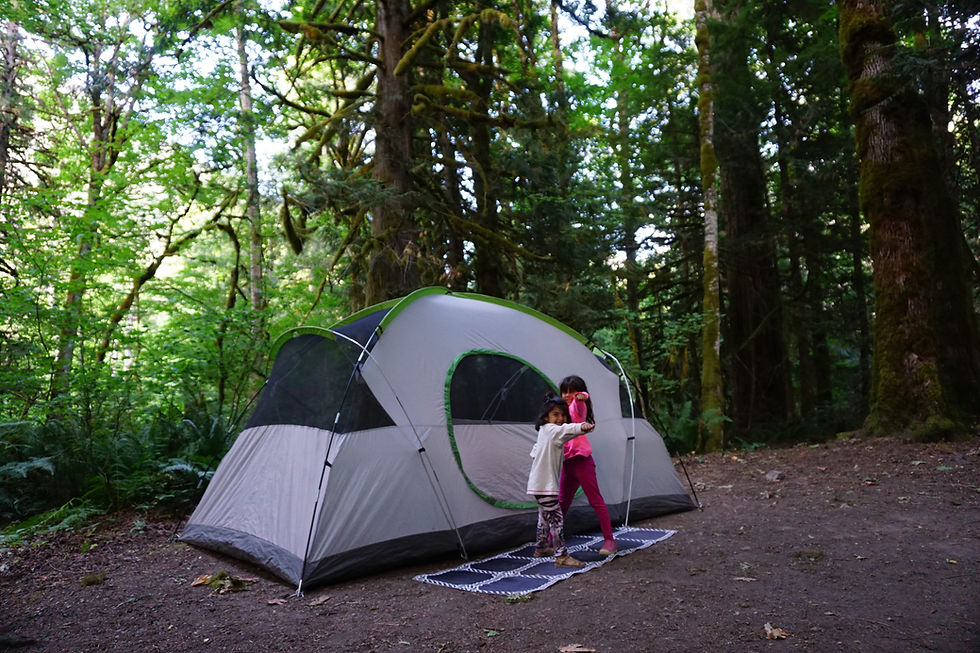
Choosing the right tent for your family comes down to one golden rule: always go bigger than the stated capacity. If a tent says it sleeps four, that means four people lying shoulder to shoulder with absolutely zero extra space. Trust me on this one.
The Big Agnes 4-person tent is one I genuinely love. But in reality it comfortably fits two to three people, not four. So keep that in mind when comparing specs while shopping.
👨👩👧👦 For Bigger Families
Look for tents with room dividers. They give you a little privacy within the tent, which is a game changer especially with older kids. Yes, they are bulkier, but for car camping where you are not hauling everything on your back, the extra size is completely worth it.
Pro tip: Always set your tent up at home before your first trip. A full trial run in the backyard or living room means no unpleasant surprises when you arrive at the campsite after a long drive with tired kids.
Shop the tent: Big Agnes 4-Person Tent on Amazon →

Essential #3: Sleeping Pads, Air Mattresses and Cots
Sleep is the single biggest predictor of whether your family camping trip is magical or miserable. Cold kids do not bounce back. Tired adults do not enjoy the sunrise. This is the section to read twice, because every sleeper in your family has different needs and the right setup is the difference between coming home wanting to do it again and coming home swearing off camping forever.
This is the part of camping that takes the most trial and error, and honestly the most personal. How you sleep at home matters out here. But I promise you: once you crack the code, your sleep quality outdoors can genuinely rival what you get at home.
Foam Sleeping Pads
As a side sleeper, I tried everything before landing on a foam pad as my personal favorite. I had an REI foam pad that was genuinely one of the best camping investments I ever made. Silent, incredibly comfortable, and honestly more supportive than my mattress at home.
💡 Money Saving Tip
Camping gear adds up fast. Keep an eye on REI Garage Sales, where you can find gently used gear at a fraction of the retail price. It is one of the best-kept secrets for building out your kit without breaking the bank.
Camping Cots
Cots were a total game changer for my husband and me. We found Cascade Mountain cots on sale, two for around $100, and after our very first trip using them we have never looked back. No deflation, no feeling the ground beneath you, and no waking up in the middle of the night wondering if your air mattress has sprung a leak.
Honest take: They are on the stiffer side and a little extra cushioning would go a long way, but the tradeoff of never deflating and staying off the ground makes them worth every penny.

Air Mattresses: An Honest Review
I have tried air mattresses. Many of them. And I am going to save you the heartache right now: I have had terrible luck with every single one. They work fine for a night or two, and then the slow deflation begins, usually at 3am when you wake up essentially lying on the ground wondering what went wrong. i actually did find one i loved at one point from rei and then my ar got broken into and 90% of my camp gear got stolen and i searched everyjwre for that mattress and never found ti again but i can say that one never deflated and packed compact and i did love it
My honest take: Between the inflating, deflating, packing away, and inevitable midnight leaks, air mattresses are more trouble than they are worth for regular camping. Save yourself the frustration and invest in a good pad or cot instead but i didtry to figure this out for a long time because i didnt wanna lose hope.
Your Sleep System: Layering Like a Pro
Comfortable camping sleep is not about one item. It is about a SYSTEM. Three common setups that work:
1. The minimalist (what I use): Foam pad on the ground plus sleeping bag. That is it. No fluff, no extras. Reliable, light, fast to set up. My favorite because it packs up small and if you invest in a lightewierght pad you could just use the same ones for bakcpacking too and yes its expensive at first but can just be used for both.
2. The cot setup: Cot plus sleeping pad on top plus sleeping bag. The pad on top of the cot is non-negotiable for warmth, because cold air flows under cots and steals body heat. The combined R-value matters more than the individual pad. we kliked this setup for a while until we use dit the tent that wasnt big enough and and the corners of our cots made holes into the tent and repaire our big agnes was a pain and so we ddcide not to use those anymore or at leats until we invest in a bigger tenta nd i dont know if thas actually going to happen since now our kids are older and now we are moving towrads separaste tents side by side so not necesaaily very importnat to get a bigger tent .
3. The air mattress setup (if you must): Air mattress plus an insulating cover or pad plus sleeping bag. Air mattresses sleep cold because the air inside cools to ambient temperature. ALWAYS layer something insulating between you and the mattress.
🧣 A Note on Extra Blankets
I am minimal and do not pack extras. But many California camping families pack a blanket per kid for layering on cold nights, especially in higher-altitude campgrounds. Know your kids and pack accordingly.
What to Know When Shopping for Sleeping Pads
When comparing sleeping pads, the most important number to pay attention to is the R-value. This measures how well the pad insulates you from the cold ground. If you want a pad that works well year-round, aim for a higher R-value.
📊 Quick R-Value Reference
R-value 1-2: Warm summer only.
R-value 3-4: Three-season. Solid year-round choice for most car camping families.
R-value 5+: Winter and cold-weather camping.
🔑 Two Things to Look For
R-value: Higher means warmer. A pad with an R-value of 4 or above is a solid year-round choice.
Noise: Some pads crinkle with every single movement. Read reviews specifically for noise before you buy, because you absolutely do not want to feel like you are sleeping on a bag of chips.
Not Sure What to Buy? Rent First.
Camping gear is expensive, and figuring out what works for your body takes a few trips. I love REI's one-year exchange and return policy. You can buy with confidence and return what does not work for you.
But if you are not ready to commit, rent first. Sports Basement and select REI locations rent tents, sleeping bags, sleeping pads, and stoves. Try a setup for one trip, decide what works, then buy the gear that actually fits your family.
This is especially smart for families who think they MIGHT love camping but are not sure. A small weekend rental cost is a tiny fraction of a $300 gear investment that ends up in the garage.
Essential #4: Sleeping Bags
❄️ The Truth About Sleeping Bag Temperature Ratings
Bag ratings are SURVIVAL ratings, not comfort ratings. A 30-degree bag means you will not die at 30. It does NOT mean you will be comfortable. For comfort, subtract 10 to 15 degrees from the rating.
My honest rule: always go colder than you think.
I sleep in a zero-degree bag year-round. I run cold and I love being able to adjust by opening or closing the bag as the night changes. If it gets too warm, I unzip the entire side and use it as a blanket. If you do not like the mummy style, this works perfectly.
My kids are the opposite. They sleep HOT. My kids sleep in 50-degree bags even when it is 30 outside and they are completely comfortable. Every sleeper in your family is different and that is okay. Pay attention to who runs hot and who runs cold and pack accordingly.
⛰️ The Big Reason to Err Colder
Altitude and mountain weather. Nighttime temps in the mountains are wildly different from valley temps. A campground forecast of 50 can easily mean 30 at altitude. Mountain weather changes suddenly. A warm afternoon can turn into a freezing night with no warning. Always pack for colder than the forecast.
✅ My Bottom Line
Go with a zero-degree bag if you can. If it gets too hot, you can unzip and use it as a blanket. If it gets cold, you are covered. The reverse is not true. A 50-degree bag in 30-degree weather is a long, miserable night.
👶 For the Kids
We have always used the REI Kindercone sleeping bags for the kids and they have been fantastic, especially for children who tend to sleep warm. I have woken up on genuinely freezing mornings to find my kids completely relaxed in a thin base layer without a care in the world.

Why Altitude and Mountain Weather Change Everything
Most beginner campers do not realize that altitude makes a huge difference on nighttime temperatures. Every 1,000 feet of elevation gain typically drops temps 3-5 degrees. A 70-degree day in the valley can mean a 35-degree night at altitude.
Mountain weather also changes suddenly. A clear, warm afternoon can turn into a freezing windy night with no warning.
The rule: pack for the COLDEST possible scenario, not the average forecast. If you are wrong, you take off layers. If you are wrong the other way, you do not sleep.
Essential #5: Pillows and the Little Extras That Make a Big Difference
You do not need to spend a fortune on a camping pillow. A good foam pillow from Costco works just as well as anything fancy, and they usually have great deals every season. And if you are car camping, remember you have the luxury of just bringing your pillow from home.
😴 The Extras I Cannot Camp Without
Earplugs: I cannot sleep without them at home, so they are an absolute non-negotiable when camping.
Eye mask: Perfect for blocking out that early morning sun if you would like to sleep past sunrise.
String lights: We hang these inside the tent every single trip and the kids love them. They add the coziest ambiance and make the whole tent feel like a little glowing sanctuary at night.
Essential #6: The Cooking Setup
If you want camping with kids to feel like a vacation instead of a punishment, your kitchen setup is everything. Hot pancakes in the morning, a real dinner at night, coffee that does not taste like dirt. This is what makes outside feel like home.
The Camp Stove
My favorite is a two-burner camp stove with a cast iron option. Two burners means coffee on one side and eggs on the other, no waiting. Cast iron means real searing and the kind of texture that makes camp food worth eating. We have used ours for three years and it has cooked breakfast for hundreds of people.
Pots, Pans, and the Cast Iron
You need way less than you think. One small pot for boiling, one bigger pot for pasta or soup, one cast iron skillet for everything else. That is it. Skip the camping cookware sets that come with eight pieces. You will use three. i really do like my gsi complete pitydoor set. all the pieces layer into one big pot and eveyrthing fits inside and its been a game chnager. its perfect for a family of 4 . Having at least one Cast iron handles fire, camp stove, and direct coals. It also seasons over time so the more you camp the better your food gets.
The Camp Kitchen Essentials
Here is exactly what lives in our kitchen box, every trip:
Cooking utensils: a spatula, a spoon, tongs, a sharp knife, a small cutting board. That is it. Anything else is overkill for car camping.
Plates and cups: we use enamel camping plates because they are nearly unbreakable and toddler-proof. Skip paper plates if you camp often, the waste adds up fast.
Coffee setup: a French press is my non-negotiable. Boil water, add grounds, wait four minutes, press. Better than any pour-over situation at camp.
Lighter and matches: bring two lighters AND waterproof matches. Backups save trips. Lighters fail at altitude or in cold weather.
Foil and ziplock bags: aluminum foil for fire-cooked dinners and easy cleanup. Gallon ziplocks for everything else.
Dish soap, sponge, and a wash bin: biodegradable soap is camping kind. The wash bin doubles as your kitchen tub at the picnic table. No more washing dishes at the bathroom sink.
Essential #7: The Cooler (and the Hack That Changes Everything)
A bad cooler ruins trips. I learned this the hard way three trips in when our food was floating in pink ice water by day two and we drove home to a fridge cleanup that smelled like regret.
What to Look For
Insulation matters way more than size. A small well-insulated cooler beats a giant cheap one every single time. Yeti, RTIC, and ORCA hold ice for 4-5 days. The cheap ones from a department store hold ice for one. The math is brutal.
Get a size up from what you think you need. You always pack more food than you plan to. Plus you need room for the gallon water jugs (more on that in a second).
🧊 The Cooler Hack That Changed My Life
Pre-freeze gallon jugs of water and use them INSTEAD of ice bags. They keep your cooler cold for 2-3 days, AND as they melt you have ice-cold drinking water. No soggy food, no melted ice mess, no mid-trip ice runs. I freeze 4 gallon jugs for every family trip. This single habit saves me $15 in ice every weekend and keeps food from getting waterlogged.
How to Pack a Cooler
Order matters more than people realize:
Layer 1 (bottom): frozen gallon jugs. They are your thermal foundation.
Layer 2: raw meat in sealed bags. Coldest spot, lowest cross-contamination risk.
Layer 3: dairy and eggs in their own container.
Layer 4 (top): produce, snacks, and anything you grab often. Easiest to reach.
Pro tip: Pack your cooler in the order you'll eat. Day-1 dinner items at the very top. Day-2 breakfast below. Day-2 dinner at the bottom. You won't dig through every meal looking for tomorrow's eggs.
Essential #8: Lighting at Camp
It gets dark at camp in a way it never does at home. The kind of dark where you cannot see your hand. Good lighting is the difference between a magical evening and a stressful one.
Headlamps (One Per Person)
This is non-negotiable. Every single person in your family gets their own headlamp, including the toddler. The toddler will use it. Trust me. Get the kind with red-light mode so you are not blinding everyone at 2am when someone needs the bathroom.
Shop the headlamps: [ADD AMAZON LINK]
A Lantern for the Picnic Table
Headlamps are great for moving around, but they are terrible for sitting at a picnic table eating dinner. A battery-powered lantern (or a rechargeable one) lights up the whole table and feels way less harsh than headlamps shining in everyone's eyes.
String Lights for the Tent
This is the one I keep mentioning because my kids ask for it every trip. Battery-powered string lights inside the tent turn it into a glowing little sanctuary at night. Costs $10. Worth every penny. The kids still talk about "the tent that glows."
Essential #9: Camp Furniture & The Hammock That Changes Everything
Camp Chairs
One per person. The cheap ones are fine to start, but if you camp regularly, invest in chairs with a higher seat (easier on your back) and a cup holder. Sit in your camp chair for hours over the course of a weekend. A bad chair shows up by Saturday afternoon.
The Hammock
If I had to pick ONE non-essential item that has transformed our camping trips more than anything else, it is the hammock. We hang one between two trees the moment we arrive and my kids spend hours in it. They read in it. They nap in it. They argue about whose turn it is in it. They call it "the swing tree."
🌳 Why Hammocks Are Worth the Space
They take up almost no room (rolls down to the size of a water bottle), they cost $25, and they create instant entertainment without any setup. If your kids are 4 and up, this is the best $25 you will ever spend on camping gear.
Shop the hammock: [ADD AMAZON LINK]
A Folding Table (Optional but Game-Changing)
If your campsite has a picnic table, you do not need this. But if you camp in places without one, a small folding table doubles as your kitchen prep area, your kids' art station, and your evening game spot. Worth it for frequent campers.
Essential #10: Fun at the Campsite (How to Keep Kids Happy for Hours)
Most parents pack for sleeping and cooking and forget to pack for ENTERTAINMENT. Then they show up at camp with kids who finish exploring in 20 minutes and start asking when they can leave. Here is how I keep my three kids busy for entire weekends without screens.
Sidewalk Chalk
Sounds basic. Is genius. Hand kids chalk and point at any flat surface (the picnic table, a smooth rock, the side of a campsite post if it is washable) and they will entertain themselves for an hour easily. Drawings, hopscotch, name tags for their tent. Bring a big bucket.
Board Games & Card Games
The card and board game rotation that has earned its spot in our camping tote:
UNO: the universal camping game. Everyone knows how to play. Travels in a tiny box. Lasts forever.
Mancala: comes in a folding travel version. Works for ages 5 and up. Slows kids down in the best way.
Spot It: the smallest, fastest game ever. Plays in 5 minutes. Everyone can play even at 3 years old.
Travel chess or checkers: for the older kids who want something competitive.
Connect 4 (travel version): classic, easy, two-player wins.
Outdoor Toys & Activities
Glow sticks: hand them out at sundown. Magic. Kids will run around for an hour. Cheap, no batteries, work even when wet.
Nature scavenger hunt: print a list of 10 things to find (a leaf bigger than your hand, a rock that fits in your pocket, a feather, etc.). Hand it to kids on the drive in. Occupies them for hours.
Watercolors and a sketchbook: we love painting at the campsite. The kids paint trees, the fire pit, each other. Bring a small jar for water. The art that comes home is treasured forever.
A real ball: a soccer ball, a frisbee, or a kickball. Outside time becomes endless when there is a ball.
Water guns or spray bottles: if it is hot, this is the move. Cool kids down. Endless laughter. Cleanup is whoever loses.
The Quiet Time Stash
For the moments when the kids are tired but not yet ready to sleep:
Books: one or two each. Read by headlamp in the tent. Magical.
A nature journal or sticker book: focused, calming, contained.
A disposable camera (older kids): they love taking their own photos. The waiting-to-develop part teaches patience too.
Essential #11: Water & Hydration
Most beginner campers underestimate water dramatically. Plan for 1 gallon per person per day for drinking, cooking, and hand washing, plus 2 extra gallons per day for dish washing.
A family of 5 on a 2-night trip needs roughly 15 gallons. Sounds like a lot. It is. But running out is a trip-ender, especially with kids.
💧 The Potable Water Loophole
If your campground has potable (drinkable) water on site, you only need to bring enough for the drive plus the first few hours, plus one backup jug in case the tap is broken. This saves you 80% of the water haul. Always confirm before you leave home, because not all campgrounds have it.
Water Bottles
Each kid gets their OWN reusable water bottle, ideally with their name on it. Hydroflasks or Yeti Ramblers if you can swing them, generic insulated bottles otherwise. Stainless steel keeps water cold all day even in the sun.
Shop the bottles: [ADD AMAZON LINK]
Essential #12: Fire-Starting Essentials
Starting a fire from scratch with damp kindling and a frustrated kid watching is its own kind of stress. Make it easy on yourself.
Two lighters AND waterproof matches: redundancy is the only fire-starting strategy that never lets you down.
Fire starter: either commercial fire starters (Pull Starts and Light My Fire are cheap and dependable) OR free fire starter from your dryer lint. Stuff dryer lint into a paper towel tube and you have hours of starter material for free.
Firewood (buy at or near the campground): most parks ban out-of-area wood to prevent invasive pests. Plan to buy 1 bundle per night of fire on site or just outside the park entrance. Bring cash, most camp stores are cash-only.
A small camp axe or folding saw: not strictly necessary for car camping, but useful for breaking down kindling or larger logs. Optional for first trips.
Essential #13: The Random Stuff That Saves Trips
Every veteran camper has a list of weird items they pack that have saved a trip at least once. Here is mine.
Duct tape: ripped tent, broken cooler handle, blistered heel, busted backpack strap. Wrap a foot of it around a water bottle to save space.
A multi-tool or pocket knife: opens cans, fixes stuff, cuts cord, slices fruit. The most useful camping item under $40.
A spray bottle: a $1 plant mister handles cleaning faces, cooling kids off, washing small cuts, and putting out tiny stray sparks. Magic.
Paracord (50 ft): clothesline, tarp ridgeline, replacement boot lace, kid harness for sketchy moments near water. Always useful.
A collapsible laundry basket: doubles as gear organizer, dish drying rack, kid bath for little ones, trash holder, and firewood carrier. Most-used item in our setup.
A small rug for the tent entrance: keeps the inside of your tent 80% less dirty. One cheap Ikea rag rug. Game changer for tent peace.
Trash bags (contractor size): bring 3-4. Doubles as wet gear bag, dirty laundry bag, last-resort emergency rain cover.
A cheap $5 wallet of cash: most camp stores, firewood vendors, and laundromats near campgrounds are cash-only. Bring $40 in small bills minimum.
Essential #14: Personal Items That Actually Matter
This category is where most beginner campers overpack. Here is what actually earns its place.
Sunscreen (SPF 30+, scent-free): scent-free is important because bears and raccoons are drawn to coconut-scented anything.
Bug spray: picaridin-based for kids (gentler than DEET) and a stronger DEET option for adults if you are heading anywhere with mosquitoes or ticks.
Wet wipes (huge pack): for hands, faces, gear, tables, kids, the cooler when it gets sticky. The single most-used item in our personal kit.
Hand sanitizer: backup to wipes. Essential before meals.
Toilet paper (extra roll): most pit toilets run out. Be the family who has their own. Friends will be grateful.
A travel prayer mat: thin, foldable, weighs almost nothing. Transforms any patch of ground.
All medications + a written list: epi-pens, inhalers, prescription meds, plus the basics (Tylenol, Benadryl). Bring more than you think.
Essential #15: First Aid (The Basics Every Camping Parent Needs)
You do not need wilderness medical training to camp safely. You need a real first aid kit that has been opened at least once before the trip.
What is in mine:
Bandaids in multiple sizes: plus butterfly closures for bigger cuts.
Antibiotic ointment: Neosporin or generic. Every scraped knee gets it.
Tweezers: for splinters and ticks. Sharp pointed tip is best.
Kid and adult pain relievers: Tylenol and Motrin. Different ages need different doses, bring both.
Benadryl: for bee stings, allergic reactions, and unexpected rashes.
Burn cream or aloe: for fire ring burns and sunburns.
Anti-itch cream: for the bug bites that happen anyway.
Electrolyte packets (Pedialyte or similar): for kids who get dehydrated faster than adults realize.
Shop the first aid kit: [ADD AMAZON LINK]
🚨 The Three Most Common Camping Injuries
Minor burns from fire rings or hot pots (keep a 3-foot fire radius little ones can't cross), cuts from sticks and rocks (closed-toe shoes around camp always), and bug bites (apply repellent at dawn and dusk, do a full tick check before bed). 90% of camping injuries fall in these three categories. Prevention is your real first aid.Your Free Camping Checklist
Now that you have the gear sorted, the last thing you want is to get to the campsite and realize you forgot something important. I have put together a free printable camping checklist covering everything you need so you can pack with total confidence every time.


Comments